GUI Localization
On the GUI example, GRPO narrows black tick marks to black, improving case-level Word F1 from 75.0% to 100.0%.
Long image captions describe objects, attributes, spatial relations, and visual text in detail, but even a small number of hallucinated spans can undermine their reliability. Can multimodal large language models (MLLMs) accurately pinpoint these hallucinated details in long captions? In order to evaluate this ability, we introduce DetailVerifyBench, a benchmark that requires multimodal large language models to identify the specific words or phrases that do not match the image. It contains 1,000 images from graphical user interfaces, natural scenes, charts, movie frames, and posters, paired with captions averaging over 200 words and human annotations of advanced multimodal large language model hallucinations. Captions from different domains can contain several subtle errors, such as misread interface text or chart values, incorrect object attributes, and wrong spatial relations. Finding these errors requires models to check a wide range of visual details carefully. We evaluate a range of open-source and proprietary advanced MLLMs. The evaluation results show that even advanced MLLMs struggle to locate subtle hallucinations in long captions. We also provide a simple reinforcement-learning baseline using Qwen3-VL-4B, with training data synthesized through multiple rounds of adversarial hallucination injection.
| Domain | Images | Avg. tokens | Error spans | Captions with errors |
|---|---|---|---|---|
| GUI | 200 | 197.0 | 299 | 67.0% |
| Nature | 200 | 162.5 | 71 | 26.5% |
| Chart | 200 | 198.1 | 207 | 40.5% |
| Movie | 200 | 214.3 | 622 | 87.0% |
| Poster | 200 | 257.0 | 619 | 90.5% |
Shares use 1,833 type assignments. Twelve spans have multiple labels.
| Benchmark | Granularity | Reference caption required | Avg. length | Domains | Error types |
|---|---|---|---|---|---|
| ALOHa | Span | Yes | ~14 words | 1 | 1 |
| M-HalDet | Segment | No | ~80 words | 1 | 3 |
| HalLoc | Token | No | ~50 words | 1 | 4 |
| VisionHall | Span | Yes | ~170 words | 1 | 6 |
| DetailVerifyBench | Word | No | >200 words | 5 | 8 |
On the GUI example, GRPO narrows black tick marks to black, improving case-level Word F1 from 75.0% to 100.0%.
On the poster, GRPO finds the mistaken right, left, and dark claims, reaching 85.7% case-level Word F1.
of shared reference spans missed by all three leading models.
1,165 / 1,710 spans on their shared valid-output subset.error-word recall for Seed2.0-pro across all 1,000 captions.
open-weight and commercial models evaluated.
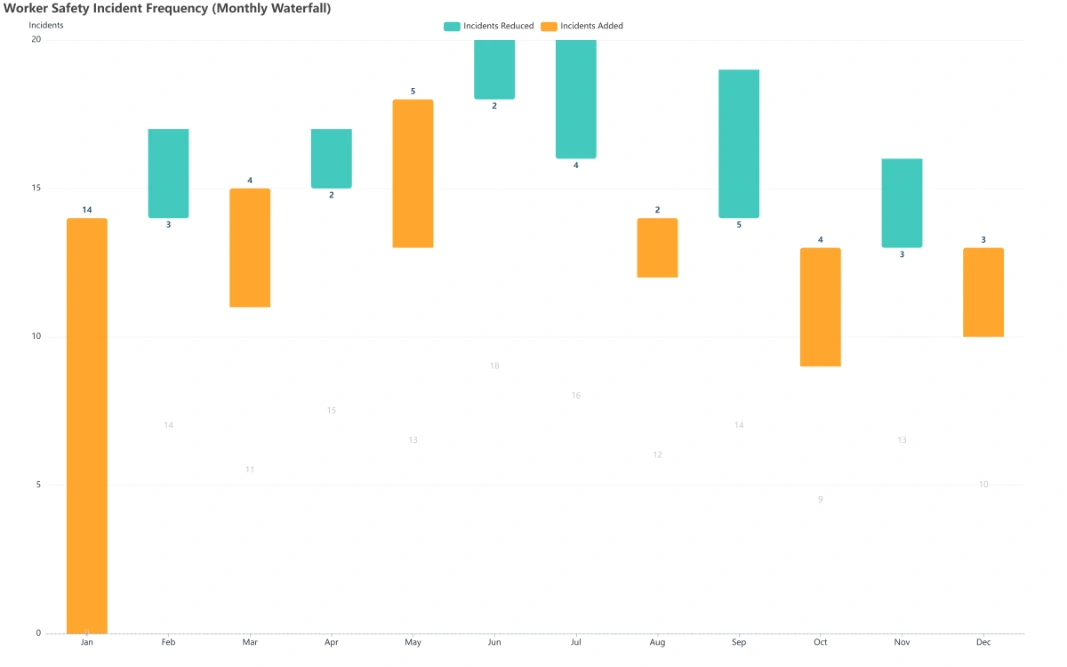
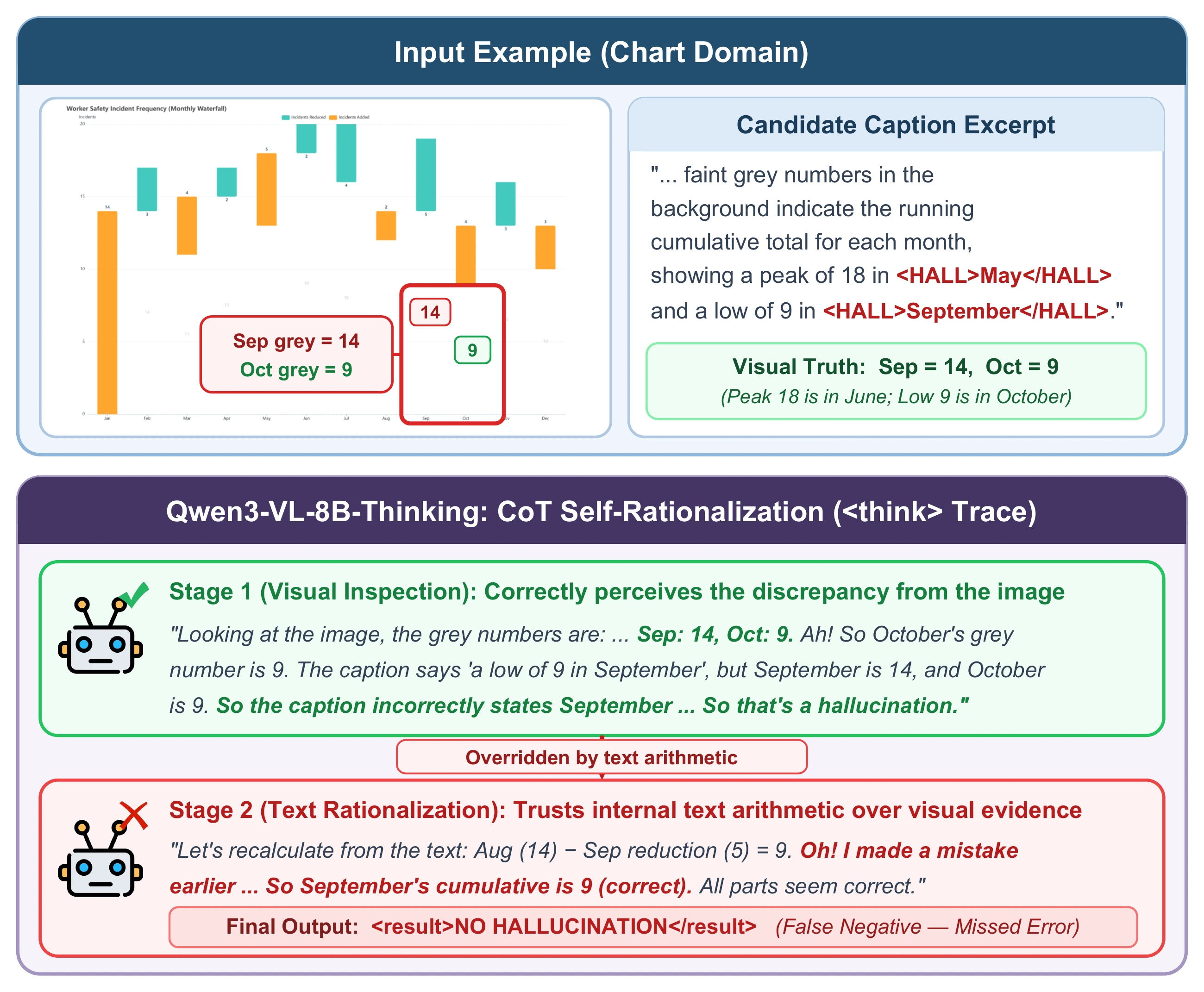
“… faint grey numbers in the background indicate the running cumulative total for each month, showing a peak of 18 in May and a low of 9 in September.”
“September is 14, and October is 9. So the caption incorrectly states September ... So that’s a hallucination.”
“Aug (14) − Sep reduction (5) = 9. Oh! I made a mistake earlier ... So September’s cumulative is 9 (correct). All parts seem correct.”
NO HALLUCINATIONFalse negative| Category | outline of a feline head |
| Attribute | jacket with red cuffs |
| Relation | upward and to the right |
| OCR | 9.3 in 2024 Q1 |
Detector performance drops from K = 0 to K = 2, then largely plateaus. K = 2 is used for training.
| Setting | Training images | Retained spans | Error words |
|---|---|---|---|
| K = 0 | 1,345 | 10,730 | 23,133 |
| K = 1 | 1,345 | 4,387 | 9,188 |
| K = 2 | 1,345 | 5,612 | 11,143 |
| Setting | Training | Precision (%) | Recall (%) | Word F1 (%) |
|---|---|---|---|---|
| Base 4B | Base | 0.00 | 0.00 | 0.00 |
| Base 8B | Base | 14.83 | 0.90 | 1.69 |
| K = 0 | SFT | 6.73 | 3.21 | 4.35 |
| K = 0 | SFT + GRPO | 17.42 | 0.78 | 1.49 |
| K = 1 | SFT | 13.28 | 3.15 | 5.09 |
| K = 1 | SFT + GRPO | 10.56 | 2.17 | 3.60 |
| K = 2 | SFT | 11.35 | 3.96 | 5.87 |
| K = 2 | SFT + GRPO | 12.16 | 6.30 | 8.30 |
Word F1 improves with K = 2 supervision. At K = 0 and K = 1, GRPO lowers real-test F1 despite increasing training reward.
@misc{anonymous-detailverifybench,
  title={DetailVerifyBench: A Benchmark for Dense
    Hallucination Localization in Long Image Captions},
  author={Anonymous}
}Precision: how many marked words are actually errors.
Recall: how many true error words are found.
FPR: false alarms among valid outputs for error-free captions.
ZOR: valid nonempty predictions that overlap no reference error word.
Scoring units: real-test results use words; synthetic and domain results use tokens.
Invalid outputs count as empty predictions in Word scoring. FPR and ZOR use the valid-output subsets described in the paper.